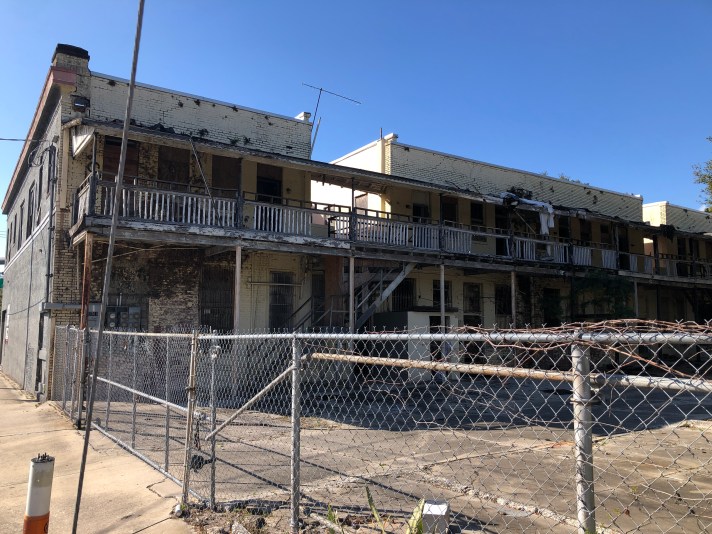
Tampa has its own approach to tackling VAD property. This includes code enforcement as well as programs to assist in home ownership and home maintenance. Given the public outcry and frustration with these spaces, it is clear Tampa can and should do more to address problematic VAD properties to promote housing, safety, and quality of life.
Policies and Procedures: Code Enforcement and Otherwise
Click the arrows to learn more about the various aspect of VAD management.
Data Management
Tampa code enforcement does not have sufficient data-tracking capabilities to implement a strategic approach to VAD property. Given the high demand on staff time and resources, proactive inspection of these spaces is difficult to maintain.
The Problems with Plywood
Many other cities, organizations like Fannie Mae, as well as the state of Ohio have recognized alternatives to plywood as the sole permissible boarding material. Polycarbonate clear boarding resembles real windows, improves aesthetics, allows visualization and inspection of the interior structure, is stronger than plywood, and does not signal vacancy and blight like plywood does.
Liens and Foreclosure
The City of Tampa does not impose foreclosures on their code enforcement liens. Sometimes these liens are settled for pennies on the dollar, with tax payers funding maintenance on absentee investors’ property. It is worth discussing how to reasonably approach the issue of liens and foreclosure.
Trespass Affidavits by Procedure
Tampa requires a yearly trespass affidavit renewal on vacant property. It is worth investigating whether this may be implemented in perpetuity, or automatically applied when properties meet quantitative criteria for vacancy.
What does “vacant” mean?
Vacancy can be hard to define. Is there a quantifiable way to determine what “vacancy” actually means? Here’s what Tampa’s code says.
In Tampa’s code, vacant means any building or structure that is not lawfully occupied or inhabited by human beings and shows “evidence of vacancy”.
Evidence of vacancy means any condition that on its own, or combined with other conditions would lead a reasonable person to believe that the property is vacant. Such conditions may include, but are not limited to: overgrown and/or dead vegetation; electricity, water or other utilities turned off; stagnant swimming pool; statements by neighbors, passers-by, delivery agents or government agents.
Elsewhere in the code, vacant applies whenever an occupying owner or tenant ceases to use the dwelling or dwelling unit as a place of abode.
Abandoned real property means any real property that is vacant and/or is under a public notice of default, notice of mortgagee’s sale, pending tax assessor’s lien sale and/or properties that have been the subject of a foreclosure sale where title is retained by the mortgagee, and any properties transferred under a deed-in-lieu of foreclosure sale, a short sale or any other legal means.
Repeat Violation Definition – Tampa’s Slumlord Loophole
Tampa’s “repeat violation” definition creates a slumlord loophole. With Tampa’s definition, the same violation may occur across multiple properties owned by the same person without an escalation in fines or expeditious processing. Instead, Tampa goes property by property, generating a separate process for each address regardless of common ownership.
Here is Tampa’s definition: “Repeat violation means a violation of a provision of a code or ordinance on the same property…”
Elsewhere in the state, the definition says: “Repeat violation means a violation of a provision of a code or ordinance by a person… notwithstanding the violations occur at different locations.“
In a market where absentee investors are more likely to own multiple VAD properties than residents where VAD property is concentrated, this definition shields absentee investors from a proportional response for the aggregate harm they cause across their portfolio.

Demolition Criteria – Setting a Threshold
Local governments implement various approaches to demolition of VAD property. Tampa’s approach appears to be an anomaly among populous local governments.
Tampa does not enforce demolition until a building is damaged, deteriorated or defective such that the cost of restoration or repair will exceed 75% of the assessed value of the building.
In most cases, local government codes list the unsafe building conditions that trigger an order for demolition or repair. The building official inspects the building and guides a determination using Florida Building Code standards. What does the Florida Building Code say?
The Florida Building Code defines “substantial damage” as damage of any origin sustained by a structure whereby the cost of restoring the structure to its before-damaged condition would equal or exceed 50 percent of the market value of the structure before the damage occurred.
The City of Miami, Miami-Dade County, Hillsborough County, Pasco County, City of Tallahassee, and other smaller local governments use a variation of a 50% rule in their demolition criteria.
It is important for Tampa to determine how it wishes to define its demolition criteria in light of policy best practice, Florida Building Code, and other technical standards.
Just like other local governments, emergency demolition is deemed appropriate in Tampa when a structure poses a serious threat to public health, safety, or welfare.
Proactive Enforcement – A Beneficial Strategy
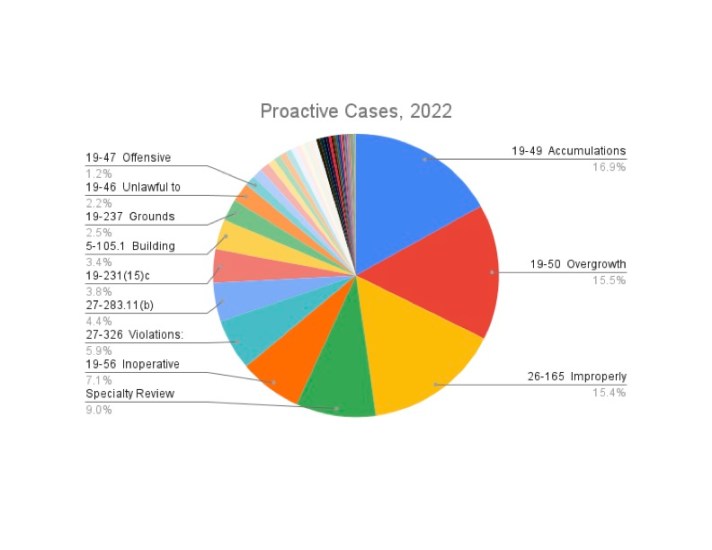
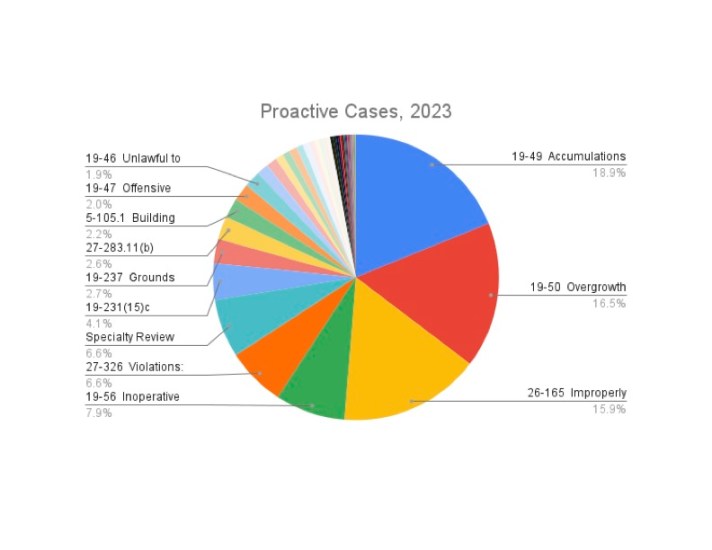
Tampa’s Neighborhood Enhancement Division (code enforcement) proactively monitors and cites violators. The most frequently cited violations include…
- Sec. 19-49. – Excessive accumulation of debris, rubbish, trash, etc.
- Sec. 19-50. – Excessive undergrowth, etc.
- Sec. 26-165. – Improperly prepared curbside accumulations of solid waste.
These charts show the percentage of violations from proactive cases between 2020-2023. The citations issued most frequently relate to conditions that are visible from the street, as might be expected.


Protecting Home Ownerships
The City and the Community Redevelopment Agency do not include information about estate planning or refer grant applicants to organizations that can provide estate planning resources. There is no requirement that grant applicants demonstrate they know how to protect their assets for the next generation. This may be a fixable problem.
Housing, Rehabilitation, Grants, and Programs
The City of Tampa and the Tampa Community Redevelopment Agency offer a number of grants and programs to assist with homeownership and structural maintenance. These provide critical resources to prevent property from slipping into vacancy, abandonment, and deterioration.
Community Redevelopment Agency Grants/Programs
- Commercial Interior Grant
- Commercial Exterior Grant
- Predevelopment Grant
- Special Projects Grant
- Down Payment Assistance Program
- Housing Rehabilitation & Renovation Program (HRRP)
- Infill Housing Program
- Unit Creation & Conversion
- Legacy Credit
- Strategic Acquisition
- Environmental Crimes Detective (East Tampa)
City of Tampa Grants/Programs
- Homeownership and Financial Education Services
- Foreclosure Prevention Assistance Program (FRA)
- “Dare to Own the Dream” Homeownership Program
- Infill Housing Program
- Rental and Move-In Assistance Program (RMAP)
- Healthy Home Program (HHP)
Tell the power that be…
City Council members support the cause. But without cooperation from key players in the administration, progress will stall.
Let City Council know you’re on their side. Ask the Mayor for her staff to join us.
 Vacant to Vibrant